
Subscribe to stay informed, inspired and involved.
Subscribe
Sign up with your email

With the rise of AI adoption across the economy, data center development has become a prominent public issue in 2026, with potential technological and economic benefits on one side and uncertain societal impacts on the other. Amid public concern and uncertainty about the impacts data centers may have on local communities, water supply, energy grids, land use, and the workforce as AI models are rapidly deployed, some U.S. lawmakers have begun enacting moratoriums to slow development to investigate and address these issues.
To better understand the rapidly evolving public sentiment toward data centers, Sodali & Co surveyed 1,000 Americans from across the country about their support for or opposition to data center development. The survey gauged their level of agreement or disagreement with 20 statements about expected benefits and common concerns of data centers. This article reports the survey findings and offers our interpretation of what they may mean for engagement between data center developers (including hyperscalers) and local communities.
While Americans are nearly evenly divided on data centers nationally, they agree on local concerns
When asked the extent to which they support or oppose data centers being developed in the United States, respondents were nearly evenly split between those who support them (38%) and those who oppose them (39%), while nearly a quarter (23%) had no clear stance. A look at the underlying data shows a different story, with those who strongly oppose (26%) outweighing those who strongly support (16%), reflecting that those with stronger held views are more in opposition.

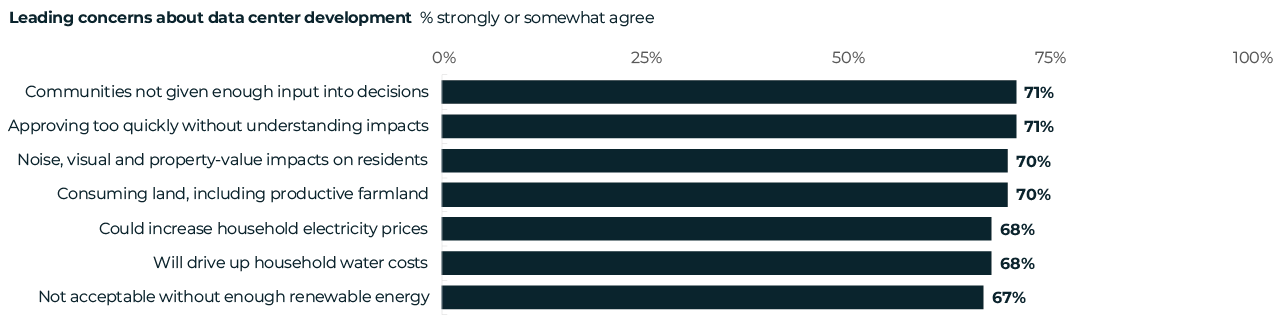
Although national sentiment is nearly evenly split, respondents shared concerns related to the potential adverse impacts of local development. The concerns with the highest levels of agreement were that:
- Community voice: Communities are not given enough of a voice to provide meaningful input to make decisions, and development approvals are moving faster than communities can engage with (71%)
- Construction impacts: Development will impact residents through increased noise, visual exposure to the developments, and lower property values (70%)
- Local utility costs: Household budgets will be impacted by rising electricity and water costs (68%)
Even respondents who support data center development at the national level share these concerns with those who oppose it.
This suggests that local acceptance is a critical consideration for individual project success.
Respondents see potential benefits, and practical safeguards could address the concerns of some opponents
Although concerns about data center development are widely shared, respondents also perceive benefits, both nationally and locally. The beliefs most strongly associated with support included the belief that data centers (percentages show each belief’s relative contribution to explaining support in a regression model, not the share of respondents who hold it):
- Are becoming as essential infrastructure as roads, electricity, and telecommunications (16.1% relative importance)
- Help to revitalize communities through local investments into public goods (e.g., schools, safety, parks) (13.9% relative importance)
- Are becoming more environmentally sustainable through improved energy efficiency and technology (11% relative importance)
- Strengthen the United States’ digital security and resilience (10.2% relative importance)
This suggests that respondents are not rejecting the potential benefits of data centers but are questioning whether the benefits outweigh the costs.
Benefits framed as national or macroeconomic may also not translate into perceived local benefits.
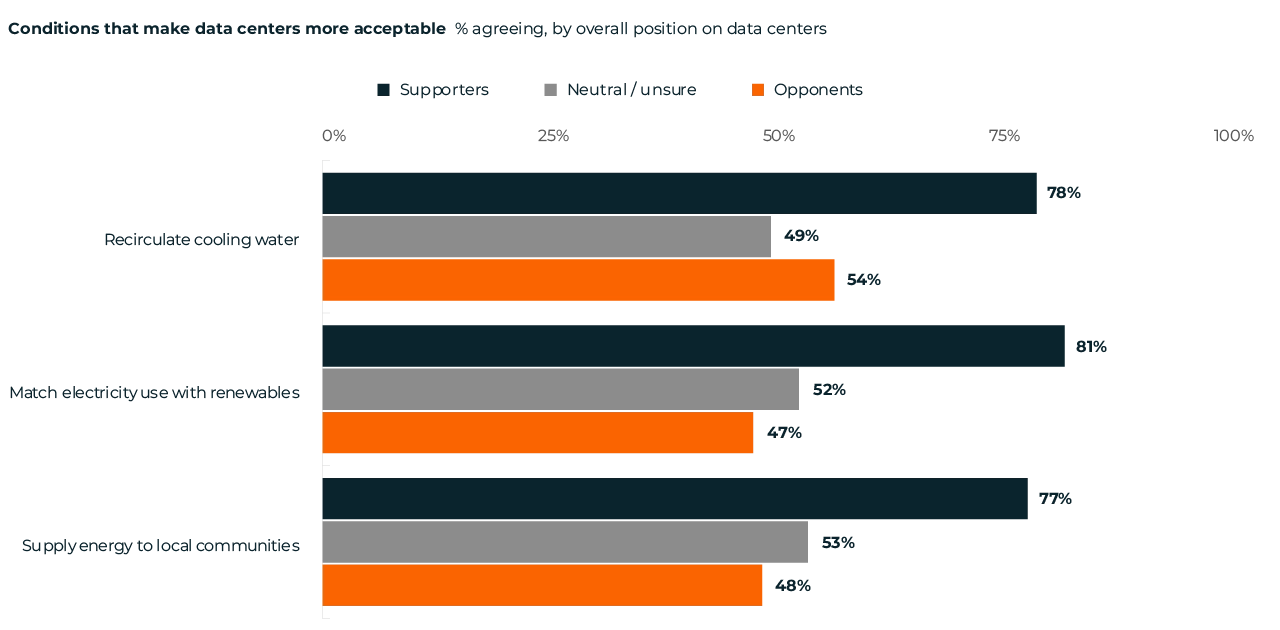
We also asked respondents which practical safeguards could build acceptance of local projects. Roughly half of those who oppose data centers (47%-54%) agreed that each of the top three safeguards would make data centers more acceptable to them.
- Recirculate cooling water rather than consistently relying on the local water supply (54%)
- Match electricity use by procuring renewable energy (47%)
- Supply energy back into the local communities (48%)
Segmentation identifies six distinct audiences, defined by how they weigh benefits and costs
Categorizing respondents only as supporters, undecided, or opponents can obscure their varied views on the perceived benefits and costs of development. A segmentation analysis of the survey responses identified six distinct audiences with different beliefs, expectations, and concerns.
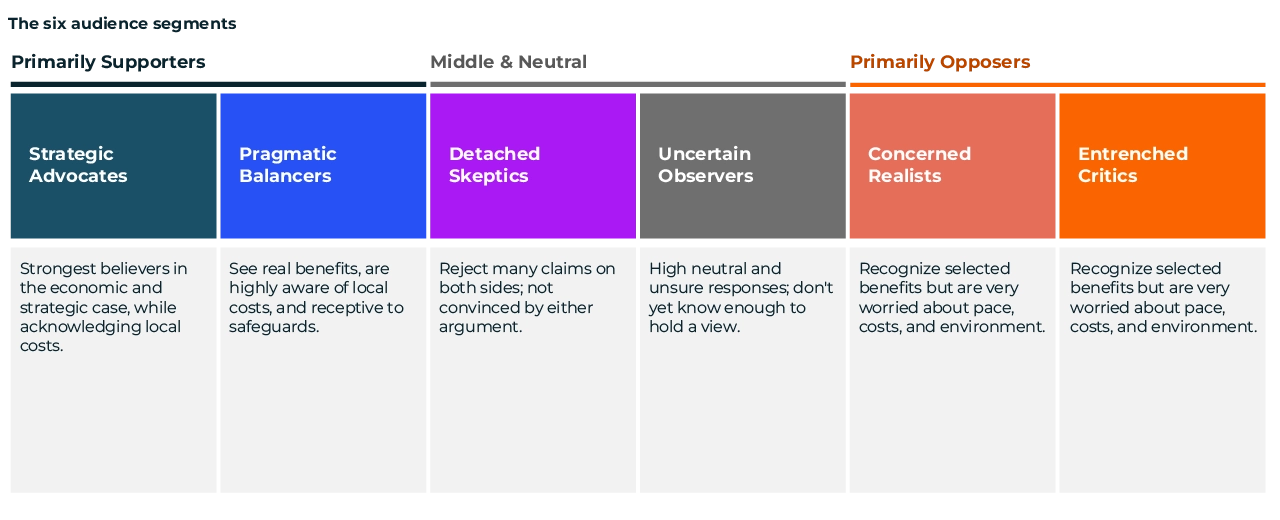
Understanding these audiences may help developers and other stakeholders better address local communities’ concerns and align on the benefits and safeguards that matter most to them. Based on our findings, we suggest the following priorities for each audience:
- Strategic Advocates and Pragmatic Balancers comprise the audiences with the greatest base support for data center development. Our recommended priority for these groups is to maintain confidence in development by addressing local concerns through responsible development.
- Detached Skeptics and Uncertain Observers are the audiences with the lowest conviction about data center development. Our recommended priorities for these groups are to engage them to identify their specific needs, provide them with education on the benefits and costs of proposed local projects, and implement community plans that align with their needs.
- Concerned Realists and Entrenched Critics comprise the greatest opposition to data center development. Our recommended priorities for these groups are to uncover the root cause of their opposition, strengthen accountability for current and future development, and demonstrate how community impacts will be managed, mitigated, or avoided.
What this means for developers: Tailoring engagement to each audience in each community
Given the complexity of public opinion, our perspective is that a one-size-fits-all approach is unlikely to meet the expectations of each audience in local communities. A targeted, localized sentiment survey of the specific communities where projects are being considered should be conducted at the onset.
Localized concerns call for localized solutions.
At a minimum, our perspective is that data center developers engaging local communities should consider the following:
- Tailor the approach to each audience within each local community, based on what is relevant, what their priorities are, and what is most likely to build acceptance for that site.
- Demonstrate, with measured and validated evidence, the steps taken to address the local community’s perceived concerns, including practical safeguards.
- Make community benefits tangible by quantifying local economic investment, permanent employment created, and direct community contributions given.
To request access to additional content about the survey results or if you are interested in conducting a local community sentiment survey, please reach out directly to sustainability@sodali.com with your inquiry.