

Subscribe to stay informed, inspired and involved.
Subscribe
Sign up with your email

What Are Building Performance Standards (BPS)?
Building Performance Standards (BPS) are local regulations that require buildings to meet specific greenhouse gas (GHG) emissions or energy efficiency performance targets that become more stringent over time.
Unlike voluntary building certifications or one-time upgrades, BPS mandate that buildings continuously improve their performance over time to meet climate goals – often through energy efficiency improvements, emissions reduction, or electrification. They offer a predictable regulatory framework that drives innovation, investment, and accountability in the built environment.
Why Should BPS Drive Boardroom Conversations?
Buildings are major contributors to climate change, responsible for roughly 30% of all operational GHG emissions in the United States[1]. As such, BPS are emerging as a core strategy for cities, counties, and states to achieve their climate targets, especially in the absence of strong federal action and support.
Often seen as a compliance obligation, BPS are increasingly proving to be a strategic asset for real estate owners, developers, and investors. Beyond reducing building-level impacts, BPS also help unlock operational savings, attract ESG-conscious tenants, improve access to capital, and align buildings with long-term climate and financial goals:
- Operational Savings: Energy-efficient upgrades can help reduce utility bills, often with short payback periods. Incentives and financing mechanisms can also help offset upfront costs.
- Tenant Demand: “Green” or sustainable buildings can command higher rents, lower vacancy rates, and stronger tenant retention[2].
- Access to Capital: High performance buildings may qualify for preferential financing terms or green bonds, with investors increasingly demanding transparent reporting of building performance data.
- Alignment with Corporate Goals: Companies with their own emissions reduction targets benefit from leasing or owning BPS-compliant buildings due to the resulting Scope 1 and 2 emissions reductions.
Boards of companies that own or manage buildings should consider BPS as a material risk driver and integrate exposure into enterprise risk and capital planning. In addition to broader risk mitigation, proactive oversight can strengthen investor confidence in long-term asset performance and resilience.
The Policy Landscape: Momentum and Funding
The current building regulations landscape is shifting from disclosure to performance. For years, most building regulations focused on transparency and planning: benchmarking ordinances required owners to measure and report on utility usage, while audit and retro-commissioning regulations aimed to identify inefficiencies and plan for upgrades. These measures improved visibility, but rarely guaranteed emissions reductions.
Now, jurisdictions are moving beyond reporting and disclosure requirements toward enforceable performance mandates. BPS do just that: they serve as legally-binding targets that tighten over time, creating a compliance trajectory rather than a one-time submission or obligation. Today, New York City, Denver, and dozens of other local jurisdictions in the United States have adopted or committed to BPS-style policies, reflecting growing pressure to achieve climate goals at scale. Despite political headwinds surrounding such goals, these jurisdictions continue to drive BPS adoption. Most recently, on December 1st, the West Hollywood City Council adopted an ordinance requiring annual benchmarking and directing the city’s Community Development Department to set interim and final building performance targets.
Compliance with BPS requires actual operational performance, not just design intent – which may come with a price tag. To help alleviate financial barriers to BPS compliance, certain jurisdictions offer funding strategies or financing mechanisms to support their constituents, among other available resources:
- Local and State Grant Programs: Dedicated funds help offset retrofit costs for building owners, particularly in underserved communities.
- Utility Rebates and Incentives: Certain energy providers offer performance-based rebates for efficiency upgrades, electrification, or other related initiatives.
- Innovative Financing Tools: Financing mechanisms like Property Assessed Clean Energy (CPACE) and green banks provide low-cost capital and long repayment terms, reducing upfront barriers.
These funding streams are essential for scaling BPS compliance to achieve meaningful emissions reductions while ensuring that compliance is accessible to all.
Implications for Real Estate Owners
For real estate owners and REITs, BPS compliance requires proactive portfolio-level planning and due diligence. Financial penalties, reputational exposure, and investor scrutiny are real consequences of noncompliance – which means that operational strategies like data access and infrastructure and capital planning must evolve towards active performance management.
Acquisition Due Diligence: BPS makes regulatory compliance a critical part of real estate due diligence. Confirming asset-level exposure to BPS requirements, ensuring that appropriate data infrastructure is in place, and assessing existing HVAC efficiency can help avoid unexpected CapEx, penalties, or reputational risk over the lifetime of an investment. Owners and REITs should consider integrating ongoing compliance checks into acquisition models and investment memos.
Data Access and Infrastructure: Buildings comply with BPS by submitting annual energy or emissions data that proves they meet prescribed emissions or efficiency targets for each compliance period. This requires complete, validated data from all tenants, spaces, and energy sources, typically due by early May, June, or July. For building owners and operators, the biggest hurdle is data access: whole-building reporting typically relies on tenant and utility cooperation, sub-metering, and lease provisions that require timely data-sharing. Without these mechanisms, compliance deadlines can be easily missed, rendering building owners liable.
Capital Planning: To meet increasingly stringent performance targets across different compliance periods, building owners will need to take a phased approach to building upgrades and improvements – starting with low-cost efficiency measures like LED lighting retrofits and eventually progressing to more capital-intensive interventions like HVAC replacement, envelope improvements, or electrification. Coordinating these projects across different asset types and tenants requires careful planning to minimize disruption and optimize ROI. BPS compliance impacts both OpEx and CapEx, so building owners should expect higher upfront investment costs for retrofits and building improvements in exchange for long-term utility savings and performance.
BPS Compliance Property Roadmap
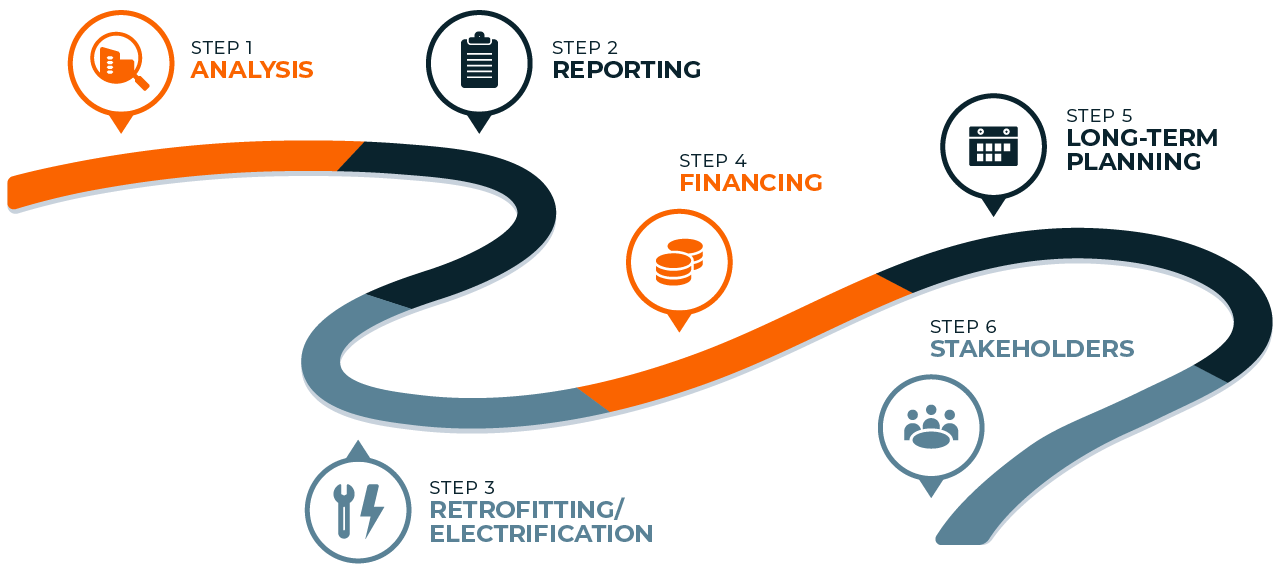
In addition to portfolio-level planning, building owners should establish a high-level plan for BPS compliance to be further tailored for each asset. The following high-level roadmap outlines the essential steps for building owners to work towards building compliance:
- Understand Your Building’s Emissions Profile: Collect complete utility data for all fuel types (e.g., electricity, gas, steam); estimate annual emissions using ENERGY STAR Portfolio Manager or local calculators; and confirm space types (e.g., residential, office, retail) as emissions limits can vary by use.
- Benchmark and Report: Submit accurate, timely emissions reports in accordance with the requirements of the local BPS and ensure data has been validated to avoid errors that can lead to fines or noncompliance.
- Evaluate Retrofit and Electrification Options: Conduct energy audits to identify cost-effective upgrades and integrate findings into capital planning. Prioritize initiatives like HVAC electrification, envelope improvements, LED retrofits, or smart controls and automation, where feasible.
- Explore Incentives and Financing: Tap into local rebates, grants, and financing programs. Explore technical assistance or compliance extensions offered by jurisdictions for good-faith efforts, where applicable.
- Plan for Long-Term Compliance: Set internal emissions targets aligned with regulatory timelines (e.g., 2030, 2040, 2050), incorporate BPS planning into long-term capital plans, and monitor policy updates as standards tighten.
- Engage Stakeholders: Communicate compliance goals to tenants, investors, and facility managers. Integrate sustainability clauses into lease contracts around tenant data-sharing and cooperation.
Those who act early – by assessing portfolio exposure, embedding BPS into long-term planning, and leveraging available incentives – will not only mitigate compliance risk but also position their assets for long-term resilience and competitive advantage. BPS compliance is not just about avoiding penalties; it’s about safeguarding asset value and defining progress by performance.
Sodali & Co is here to help your organization navigate the building regulations landscape with confidence. Regardless of where you are on your compliance journey, our team provides tailored guidance for compliance management while staying ahead of evolving regulatory requirements. Contact us at info@sodali.com to learn more.
Summary
From initial data collection to long-term stakeholder engagement, learn how to navigate the building regulations landscape.
Author

Carson Smith
Senior Associate, Sustainability
carson.smith@sodali.com

Myles Scott
Director, Sustainability, Real Estate Lead
New York
myles.scott@sodali.com