

Subscribe to stay informed, inspired and involved.
Subscribe
Sign up with your email

On July 23, 2026, EFRAG published its exposure draft of the reporting standards for Non-EU groups under article 40a of the Accounting Directive, known as ESRS-40a. For groups based outside of the EU that do significant business within it, this is the clearest indication yet of what the new regime will require.
The development is significant, but not because a final reporting standard has arrived. The key point is that this is a draft, not a final standard. What remains open to change are the details and EFRAG is using this draft as part of a 100-day consultation to collect feedback.
Consultation responses will inform EFRAG's final technical advice (i.e., final draft) to the European Commission, expected in January 2027. The Commission is then expected to run its own comment period and make additional revisions before adopting the standard.
Which non-EU groups may be affected?
Following the Omnibus I amendments, Article 40a applies where both of the following conditions are met:
- The non-EU undertaking or group level generated more than EUR 450 million in EU net turnover in each of the last two consecutive financial years; and
- It has an EU subsidiary or branch with more than EUR 200 million in net turnover in the preceding financial year.
Companies in ESRS-40a scope after Omnibus I
A company falls in scope where the non-EU company and EU subsidiary or branch criteria are both met.
THRESHOLDS AFTER OMNIBUS I
In scope of article 40a(1) of the accounting directive (2013/34/EU), as modified by the Omnibus I Directive (EU) 2026/470. EU turnover is measured at group level. Source: EFRAG, SRS-40a Exposure Draft (launch material), 22 July 2026 efrag.org
On EFRAG's analysis, the largest cohorts in scope are US-headquartered groups (350–450) and UK-headquartered groups (150–200), followed by Switzerland and Japan (100–150 each). No official list exists, and these figures are estimates rather than determinations.
Companies in scope of ESRS-40a
EFRAG preliminary estimate of in-scope companies, by jurisdiction
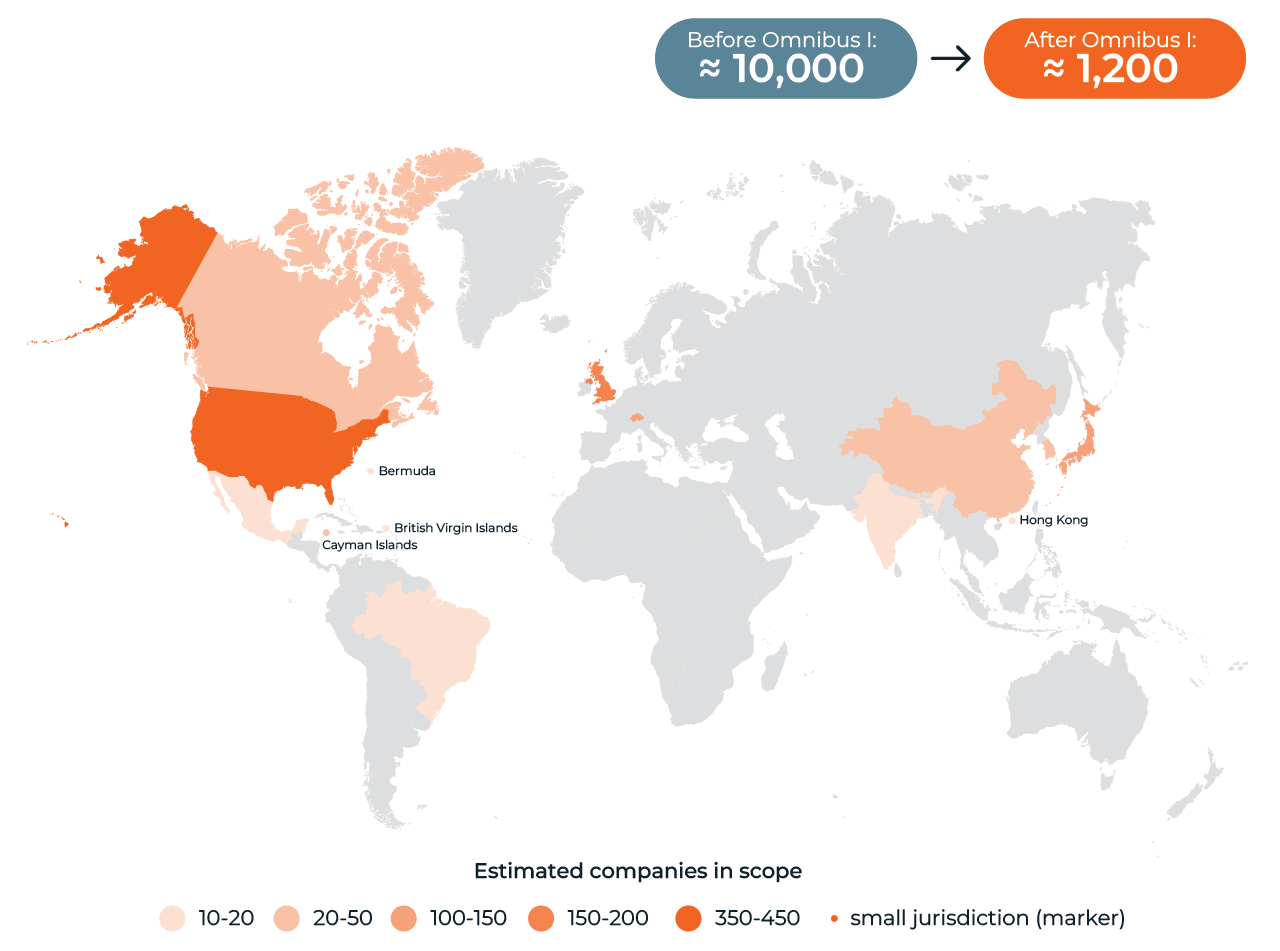
No official list exists - figures are EFRAG estimates from available data. Source EFRAG, SRS-40a Exposure Draft (launch material), 22 July 2026 efrag.org
The EU subsidiary or branch must publish the report and make it accessible. However, the report concerns the impacts of the non-EU parent group, not only the activities of the EU entity. Where there is no group, it covers the non-EU company on its own.
The result is an unusual split. The EU entity is only the place where the report is published; the report itself must cover the entire non-EU parent group, globally. If the parent does not provide all the necessary information, the EU subsidiary or branch must publish what it has and clearly identify and explain omissions.
Impact-focused does not mean climate-only
ESRS-40a retains the same overall architecture as the revised ESRS adopted by the European Commission on 3 July 2026: two cross-cutting standards and ten topical standards covering environmental, social and governance matters.
The main difference is the reporting objective. The full ESRS used under Articles 19a and 29a address impacts, risks and opportunities through double materiality. Article 40a has a narrower legal mandate, addressing only impact materiality. EFRAG has therefore drafted ESRS-40a on that basis and removed or reformulated disclosures that relate specifically to risks and opportunities on the business itself.
Materiality coverage by reporting framework
Articles 19a/29a require both financial and impact materiality; Article 40a and IFRS each cover only one.
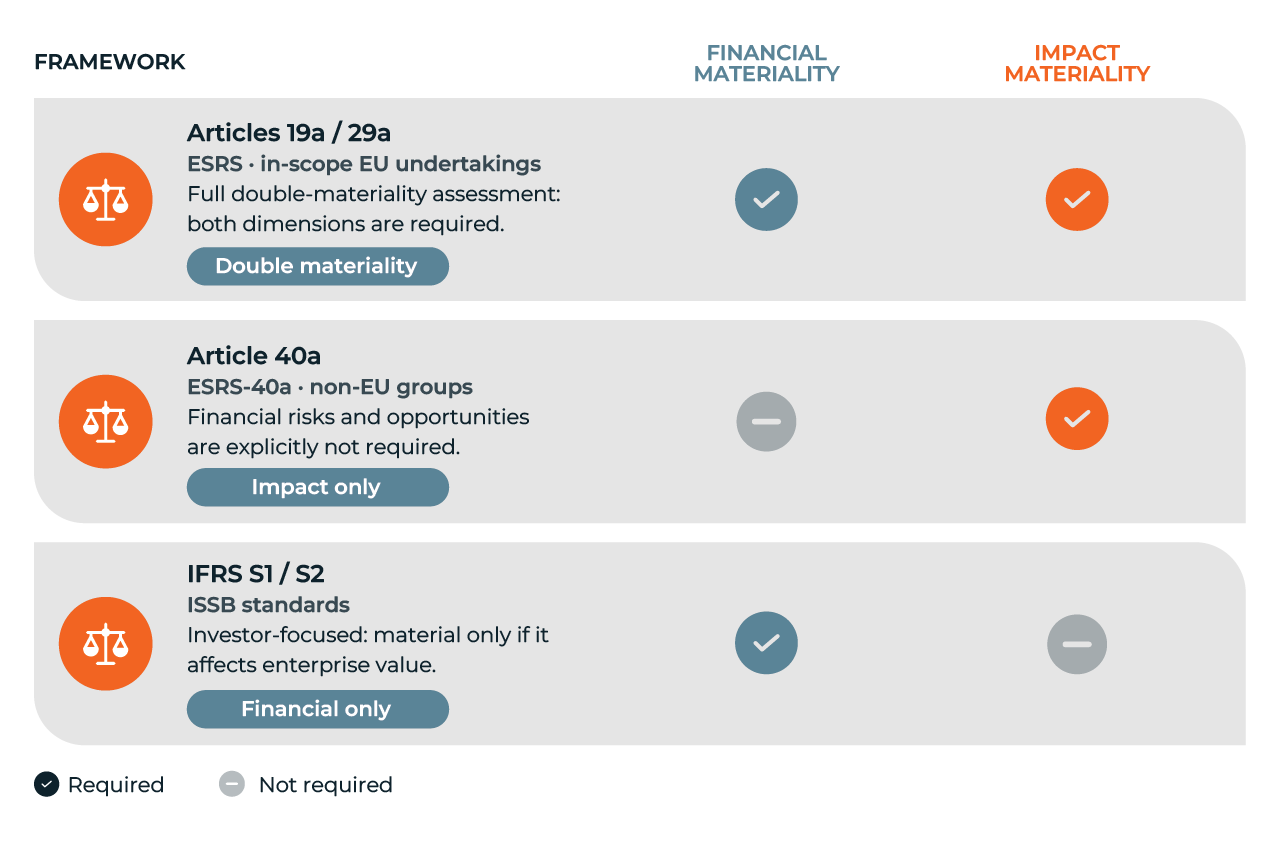
Simplified summary for discussion purposes; confirm against the final standards before external use. Source EFRAG, SRS-40a Exposure Draft (launch material), 22-23 July 2026; IFRS Foundation, IFRS S1/S2 efrag.org, ifrs.org
This makes ESRS-40a narrower than the full ESRS but not necessarily narrow in operational terms. The exposure draft still covers all sustainability topics and material impacts across own operations and the value chain. Financial information may also remain relevant where it provides context for understanding an impact, even though financial materiality is not the basis of the Article 40a assessment.
Interoperability is proposed, not resolved
Many non-EU groups already report, or are preparing to report, under jurisdictional standards based on IFRS S1 and IFRS S2. The exposure draft would permit extensive incorporation by reference, subject to conditions intended to preserve accessibility, consistency, assurance and the cohesiveness of the ESRS-40a report. This may allow groups to reuse relevant disclosures from existing jurisdictional reports.
However, the ability to reuse content is not the same as the standards being equivalent. IFRS S1 and S2 focus on what affects the business financially, while ESRS-40a focuses on the group’s impact on people and the environment. They are opposite sides of the coin of double materiality. This consultation is testing how the two regimes can operate side by side. Companies should know that meeting one does not automatically mean you meet the other.
The reporting perimeter is the central design question
A group in scope of Article 40a would have three reporting routes: the global ESRS-40a approach, the proposed mixed ESRS-40a approach, or voluntary application of the full ESRS (or equivalent standards) under article 40a(2)(b). The choice has consequences beyond the Article 40a report itself, as set out below.
Available Reporting Options
Three routes to comply once a company is in scope for article 40a

Source EFRAG, SRS-40a Exposure Draft (launch material), 22 July 2026 efrag.org
The default under the Exposure Draft is global reporting at the level of the ultimate non-EU parent’s group. The optional mixed approach would relax this for most topics: climate-related impacts would still be reported globally, but for other topics a group could limit the information to EU-related impacts where those can be meaningfully identified. "EU-related" is defined to capture both impacts connected with products or services sold or provided in the EU (or reasonably expected to be) and impacts arising from the group's own EU activities. Because the election can be made topic by topic, a single report might apply different perimeters to different subjects.
So how should companies evaluate the appropriate reporting route? The right approach depends less on the Article 40a report itself than on the rest of an entity’s footprint, and in particular on whether a group has EU subsidiaries that must report in their own right under Articles 19a or 29a. Article 40a operates separately from those obligations: an Article 40a report published at parent level does not, by itself, release an EU subsidiary that is independently in scope.
Only one of the three routes changes that. Where the non-EU parent voluntarily applies the full ESRS, or an equivalent standard, at group level, in-scope EU subsidiaries can rely on the exemption and stop reporting separately (the derogation sits in the second subparagraph of Article 40a(2) of the Accounting Directive, and the resulting subsidiary exemptions in Articles 19a(9) and 29a(8)). The global and mixed routes do not carry that benefit, so those subsidiaries keep their own obligations and the group ends up running two reporting frameworks side by side, often over much of the same data.
This turns the decision into a question of total effort, rather than the Article 40a report alone. For a group with several in-scope EU subsidiaries, the fuller route may be worth the extra work at parent level, since one group report can replace a number of separate ones and remove most of the duplication. For a group with no in-scope EU subsidiaries, or only one small one, it usually is not: a lighter Article 40a report will be enough, and full ESRS would create more work than it saves.
The mixed approach can look like a convenient middle path, but it carries a catch. Deciding what counts as "EU-related" for each topic, and applying that line consistently and in a way auditors can test, is often harder than it first appears. It is worth weighing that added complexity before assuming a narrower perimeter will be the simpler option.
In practice, groups should avoid treating CSRD scope as a single parent-level question. Three separate assessments are needed:
- Whether the non-EU group triggers Article 40a;
- Whether the individual EU subsidiaries or subgroups have their own obligations under Articles 19a or 29a; and
- Whether the conditions for a group-reporting exemption are met.
What should companies do now?
The proposals may change materially through consultation and subsequent Commission adoption. Full implementation, system redesign or a detailed ESRS-40a gap assessment would therefore be premature.
For groups that may be affected, proportionate actions at this stage are:
- Perform an initial scope screen. Confirm EU net turnover at group level for the relevant two-year period and identify any EU subsidiary or branch exceeding the EUR 200 million threshold.
- Assess the reporting pathways. Assess Article 40a at group level alongside any Articles 19a or 29a obligations that may apply to EU entities, including whether voluntary full-ESRS reporting would be preferable to two parallel routes.
EFRAG expects to submit that advice to the Commission in January 2027. The first article 40a reports are expected to cover financial years beginning on or after 1 January 2028 and to be published in 2029.
The unresolved questions remain – what the scope of the reporting perimeter is, how EU law concepts apply to entities outside the EU, and to what extent existing information can be reused – and it is precisely these questions that will determine what requirements those first reports will actually have to meet.
For now, the priority is clarity; to establish whether the group is likely to be in scope, to understand how Article 40a interacts with the group’s other EU and global reporting obligations, and to monitor how the proposed model changes through the consultation.
Sodali & Co is following ESRS-40a as it develops, and we help companies confirm whether they are in scope, weigh the reporting routes and their wider implications, and build a proportionate plan. Have questions? Please do not hesitate to contact the Sodali & Co team.
Summary
The European Financial Reporting Advisory Group (EFRAG) released an exposure draft for ESRS-40a, a reporting standard for non-EU groups with significant business in the EU, marking a key step in defining new sustainability reporting requirements. This draft is open for a 100-day consultation, with final advice expected in early 2027, followed by European Commission adoption and implementation for financial years starting 2028.
Author

Julia Sullivan
Director, Sustainability
New York
julia.sullivan@sodali.com

Hasib Nasirullah
Managing Director, Global Co-Head of Sustainability
New York
hasib.nasirullah@sodali.com

Carolina Chaparro
Manager, Sustainablity
Madrid
carolina.chaparro@sodali.com