

Subscribe to stay informed, inspired and involved.
Subscribe
Sign up with your email

A double materiality assessment (DMA) was never meant to be a one-time exercise. Yet few companies have the resources to repeat a full DMA every year, particularly as the CSRD landscape continues to evolve.
Many companies completed their first DMA around 2024. Since then, the EU’s Omnibus I package and the revised ESRS have changed the regulatory and reporting landscape, while business models, value chains and stakeholder expectations may also have evolved. Against this backdrop, simply carrying forward previous materiality conclusions can be difficult to defend.
The question isn’t whether companies should re-do their DMA every year. It’s whether they have a proportionate process for determining when previous conclusions need to be revisited and demonstrating how those conclusions were validated. Even then, the answer is rarely to re-do the assessment from scratch. A targeted approach shouldn’t be confused with a minimal one. The objective is to focus effort where it matters most, while still demonstrating that previous conclusions have been deliberately validated.
Signs it’s time to revisit your DMA
Several developments should prompt companies to consider whether their previous DMA still holds.
The regulatory and reporting landscape has evolved. Omnibus I changes and subsequent ESRS simplification have reshaped both the reporting landscape and how companies approach materiality. The revised ESRS place greater emphasis on reporting only material information, expect companies to check at each reporting date whether changes affect previous conclusions, and aim to make the DMA process more proportionate. For companies that completed their DMA under the original ESRS, these changes are themselves a reason to revisit whether the previous process and conclusions remain appropriate.
Business and value chains change. Mergers and acquisitions, divestitures, new markets, products or services, changes in suppliers and customers, and shifts in the business model can create new impacts, risks, and opportunities (IROs) or change their significance. Any one of these changes could be significant enough on its own, or several smaller changes could cumulatively become significant.
Stakeholder expectations and external risks evolve. Issues such as economic headwinds, AI governance, climate risks, geopolitics, and other emerging developments may affect what stakeholders consider decision-useful and what could reasonably affect the company’s IROs.
Internal triggers may also include changes in strategy, organizational structure, or leadership, or feedback from previous reporting and assurance processes.
Because materiality is assessed against the undertaking’s current business and value chain, these changes can render a prior assessment outdated - a signal to check that its conclusions remain appropriate and the sustainability statement stays audit-ready.
Maintain, Refresh, or Re-do: what should the approach be?
The starting point shouldn’t be “how do we repeat the DMA?” but “does our previous assessment still hold?”. A proportionate process starts with a structured check of what’s changed since the last assessment and whether it could affect prior conclusions. This check involves revisiting the key assumptions, evidence, and judgements behind the previous DMA, and identifying any areas that warrant further analysis.
The outcome of that check can then inform three possible approaches: Maintain, Refresh, or Re-do.
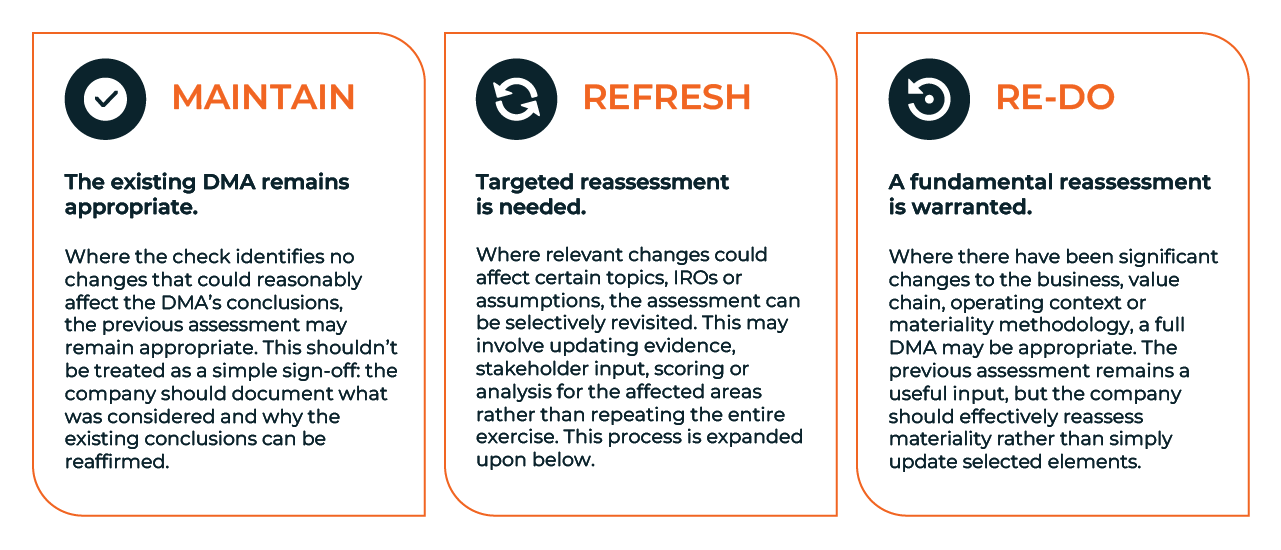
To make this approach repeatable, companies should establish a DMA refresh policy defining relevant triggers, the level of reassessment required, who makes that decision, how the outcome is reviewed and approved, and how the process is aligned with the company's enterprise risk management (ERM) systems. Such a policy adds rigor and strengthens the documentation behind the maintain/refresh/re-do decision.
What makes a DMA check defensible?
A useful way to design a DMA refresh is to work backwards from the questions an auditor is likely to ask: What changed? What did you consider? What evidence supports the conclusion? And why did you decide that a full reassessment was or wasn’t necessary?
This doesn’t mean treating the DMA refresh as an assurance exercise. It means building enough evidence into the process for an independent third party to understand and challenge the conclusions.
An auditor is likely to look for:
- A clear rationale for the scope of the refresh. The company should be able to explain why it chose to check, refresh, or re-do the DMA, based on the changes identified. A calibrated refresh isn’t necessarily a weakness, but the rationale for its scope should be clear.
- Evidence of process, not just a conclusion. Document what was reviewed, who was consulted, what evidence was considered, and how this informed the outcome.
- Consistency in methodology. Apply the same scoring, weighting, and materiality logic when reassessing existing IROs, unless there is a documented reason to change the methodology.
- Traceability from change to conclusion. Maintain a clear link between the assessment, the resulting IROs, the requirements or reporting changes that prompted the reassessment, and the resulting materiality conclusion.
- Clear ownership, review, and approval. Identify who owns the refresh and retain a documented sign-off trail.
Importantly, this applies to unchanged conclusions as well as changed ones. A company should be able to demonstrate that “nothing changed” was a considered conclusion.
Planning the refresh with these questions in mind can help companies focus effort where it matters, avoid unnecessary rework, and build the evidence they may need later to support their reporting.
How to approach a DMA refresh
Once a refresh is the right course of action, the key question is what needs revisiting? A proportionate refresh doesn’t mean giving every topic equal treatment. Four considerations can help companies focus their effort.
1. Start with a gap analysis
The refresh should begin by comparing the previous DMA and its conclusions against what has changed since it was completed. This should consider the regulatory and reporting landscape, the business and value chain, stakeholder expectations, emerging issues, and, where relevant, previous auditor or assurance feedback.
For example, an acquisition may have introduced a new geography or business activity with different potential negative impacts, while a significant change in the supply chain may alter the likelihood or severity of an existing IRO. The objective isn’t to find reasons to change the DMA, but to identify where the previous assessment may no longer be sufficiently supported or where developments warrant deeper investigation.
2. Prioritize the areas requiring reassessment
Not every topic or IRO needs the same level of attention. Effort should be concentrated where there has been a significant change, where conclusions were close to the materiality threshold, where evidence is limited, or where conclusions have previously been challenged.
An example might be where an IRO was only marginally below the materiality threshold in the previous assessment. Relatively small changes in the underlying evidence may warrant a closer look. By contrast, an IRO with a clear and well-supported conclusion may require only a lighter review.
3. Consider stakeholder engagement and evidence
A refresh should be supported by appropriate evidence rather than relying solely on the previous assessment. Depending on the changes identified, this could include updated internal data, external research, peer analysis, stakeholder feedback, or relevant regulatory or industry developments.
For instance, updated employee survey results, incident data, or supplier risk assessments could provide new evidence relevant to particular IROs. Stakeholder engagement doesn’t need to be repeated in full, but it should be targeted to areas where updated perspectives or evidence could reasonably affect the conclusion.
4. Re-test and document the methodology
Scoring and weighting should be applied consistently. However, a DMA’s methodology may need to change, for example if a company’s ERM scoring or thresholds are updated, or if more prescriptive guidance in the revised ESRS on considering controls and mitigation efforts requires it. Where conclusions change, the rationale should be traceable from the identified development through to the revised conclusion. Equally important is documenting why conclusions didn’t change. A defensible refresh should make clear what was considered, what evidence was reviewed, and why reaffirming the conclusion was appropriate.
What comes next?
A refreshed DMA isn’t the finish line. It should provide the foundation for the next stage of reporting preparation.
Updated materiality conclusions should feed directly into an ESRS gap analysis, helping companies assess the implications for disclosures, data, policies, processes, controls, governance, ownership, and alignment with ERM systems.
This step takes on added importance under the revised ESRS, where fewer data points are potentially in scope and materiality plays a greater role in determining reporting requirements. A robust gap analysis is critical to identifying what needs to be reported, where further work is needed, and how to prioritize it.
The takeaway
A DMA refresh isn’t about starting over, and it isn’t about rubber-stamping previous conclusions either. It is about showing, with evidence, why current conclusions still hold or why they have changed.
That distinction matters more than it used to. Regulators, auditors, and investors are asking sharper questions of sustainability disclosures, and an unexamined DMA is no longer a safe default. Under a narrower ESRS dataset, each remaining disclosure carries more weight, and each materiality conclusion behind it faces closer scrutiny.
The companies best positioned going forward won’t be the ones with the most exhaustive assessments. They will be the ones that can explain, clearly and with evidence, why their materiality conclusions still stand.
Please reach out to Sustainability@sodali.com if you have any questions.
Summary
CSRD double materiality assessments require evidence-based review, not automatic annual repetition, as regulations, businesses, and stakeholder expectations change. Companies should decide whether to maintain, refresh, or re-do prior conclusions through a proportionate, documented process.
Author

Julia Sullivan
Director, Sustainability
New York
julia.sullivan@sodali.com

Sabrina Bennis
Manager, Sustainability
London
sabrina.bennis@sodali.com

Edoardo Marras
Analyst, Sustainability
New York
edoardo.marras@sodali.com