

Subscribe to stay informed, inspired and involved.
Subscribe
Sign up with your email

Key Takeaways
- From May 1, 2026, revised Financial Supervisory Service (FSS) disclosure requirements call for increased transparency and performance linkage; aggregate and average director as well as auditor pay alongside operating profit and TSR, over a three-year reporting period, with realized and unrealized equity awards shown separately.
- Korea continued to display signs of increased scrutiny on remuneration in 2026: an April 2026 Supreme Court ruling reinforced past precedent limiting shareholder-directors from voting on remuneration resolutions affecting themselves, while activists filed pay-related shareholder proposals.
- Across major markets, expanded disclosure has typically been followed by greater shareholder scrutiny and eventually say-on-pay votes.
What’s Changing
Korea’s remuneration disclosure regime has entered a new phase. Effective May 1, 2026, the Financial Supervisory Service’s revised disclosure forms require listed companies to present both aggregate and average director and auditor compensation alongside performance indicators such as operating profit and Total Shareholder Return (TSR).
The reporting period has been extended to three fiscal years, while disclosure requirements have been strengthened to distinguish between realized and unrealized equity-based compensation on an individual basis. Following the introduction of named pay disclosure in 2013, these changes represent the most significant strengthening of Korea’s remuneration reporting requirements in more than a decade.
Why It Matters This AGM Season
This reform coincides with heightened scrutiny during the 2026 AGM season. An April 2026 Supreme Court decision restricting shareholder-directors from voting on remuneration resolutions affecting themselves, has brought greater attention to pay caps. Activist investors have also submitted remuneration-related shareholder proposals at several listed companies.
Regulators have signaled that they are considering additional measures, including say-on-pay mechanisms and clawback provisions for financial holding companies. However, the scope and timing of any such reforms remain undetermined.
The Global Trend
Our review of nine major markets—the UK, US, selected EU jurisdictions, Australia, South Africa, Canada, Japan, Hong Kong and Singapore—reveals a clear pattern of progression: the introduction of mandatory disclosure leads to greater shareholder scrutiny accelerating the shift towards a say-on-pay vote (with or without binding consequences for the Board).
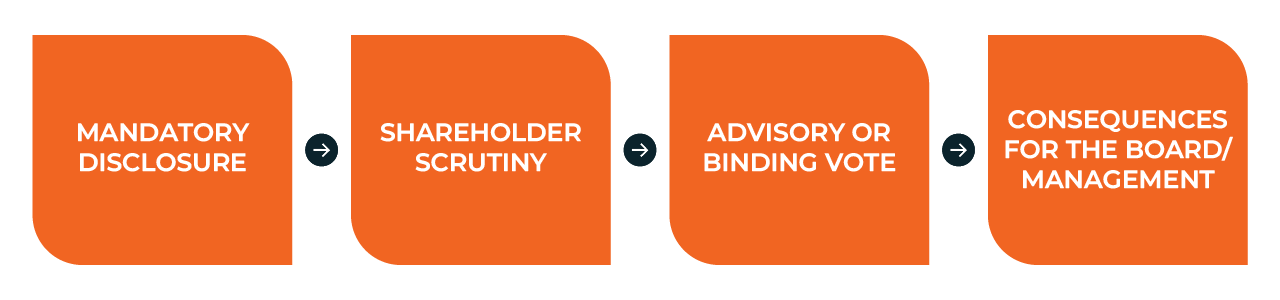
Korea’s 2026 reforms reflect a broader global trend toward greater transparency and accountability around executive remuneration. In Australia, the say-on-pay vote was introduced alongside mandatory disclosure in 2004. In the UK, an advisory vote followed just a year after expanded disclosure requirements in 2002, while EU member states have implemented remuneration reporting and voting requirements within two years of the Shareholder Rights Directive II.
The pace of progression has sped up considerably over the years. It took the US approximately 19 years to move from expanded disclosure requirements in the early 1990s to an advisory vote in 2011, while Canada took more than 20 years to reach a voluntary vote in 2010.
These examples do not establish an inevitable path for Korea. They do, however, demonstrate how enhanced disclosure can intensify investor scrutiny of executive remuneration in terms of performance alignment and board accountability, catalyzing the shift towards a say-on-pay vote.
What This Means for Korean Issuers
Korean companies are already experiencing increasing scrutiny of remuneration caps and disclosures from investors and proxy advisers. With enhanced requirements applying to semi-annual reports, companies will need to pay particular attention to remuneration-related disclosures and AGM resolutions as investor expectations and Korea’s regulatory framework continue to evolve.
For now, these developments create potential resolution risk for companies that do not adequately address the rationale behind their remuneration caps, demonstrate how pay aligns with performance and provide required granularity in disclosure.
For Korean issuers, this raises a practical question:
Does your company clearly demonstrate how executive pay aligns with performance and long-term shareholder value?
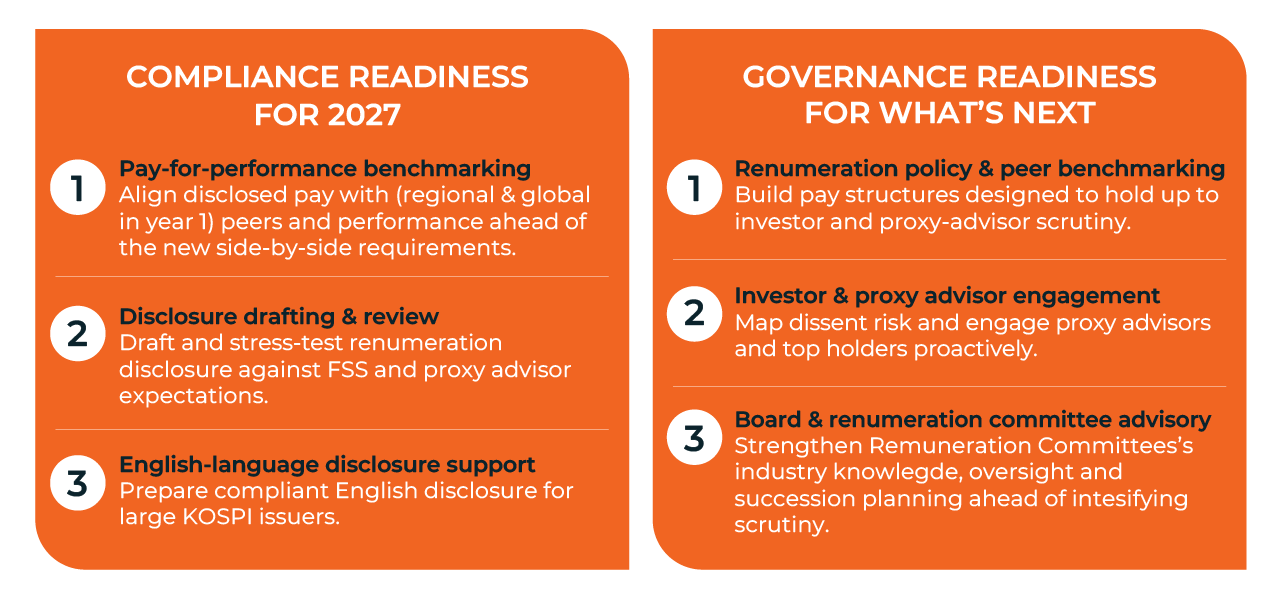
Key Considerations for Korean Companies
About Sodali & Co
Sodali & Co supports listed companies in navigating these evolving remuneration requirements, drawing on the expertise of a team with experience across proxy advisory firms, institutional investors and remuneration consultancies in Korea and the broader Asia-Pacific region. Our work includes pay-for-performance design and benchmarking, remuneration disclosure review, and engagement strategies for communicating effectively with foreign institutional investors and global proxy advisers.
Reach out to our team to discuss how we can support your company in preparing for these evolving remuneration requirements.
Summary
Korea’s remuneration disclosure regime is entering a new phase. With enhanced disclosure requirements and growing investor scrutiny, companies face increasing pressure to clearly demonstrate the link between executive pay and performance.
Author



Related Reports