
Subscribe to stay informed, inspired and involved.
Subscribe
Sign up with your email

The 2026-27 Federal Budget, handed down on 12 May 2026, includes a package of proposed changes to sustainability reporting requirements under the Corporations Act 2001. Australia’s mandatory climate disclosure regime has been in place for less than two years, and these measures signal the Government’s intention to refine its settings.
Under the AASB S2 standard, entities are phased into mandatory climate reporting obligations across three groups determined by size, with Group 1 (the largest) already reporting, Group 2 commencing for financial years beginning 1 July 2026, and Group 3 from 1 July 2027.
For many Australian entities, the implications are worth understanding now.
The key proposed change: Higher reporting thresholds
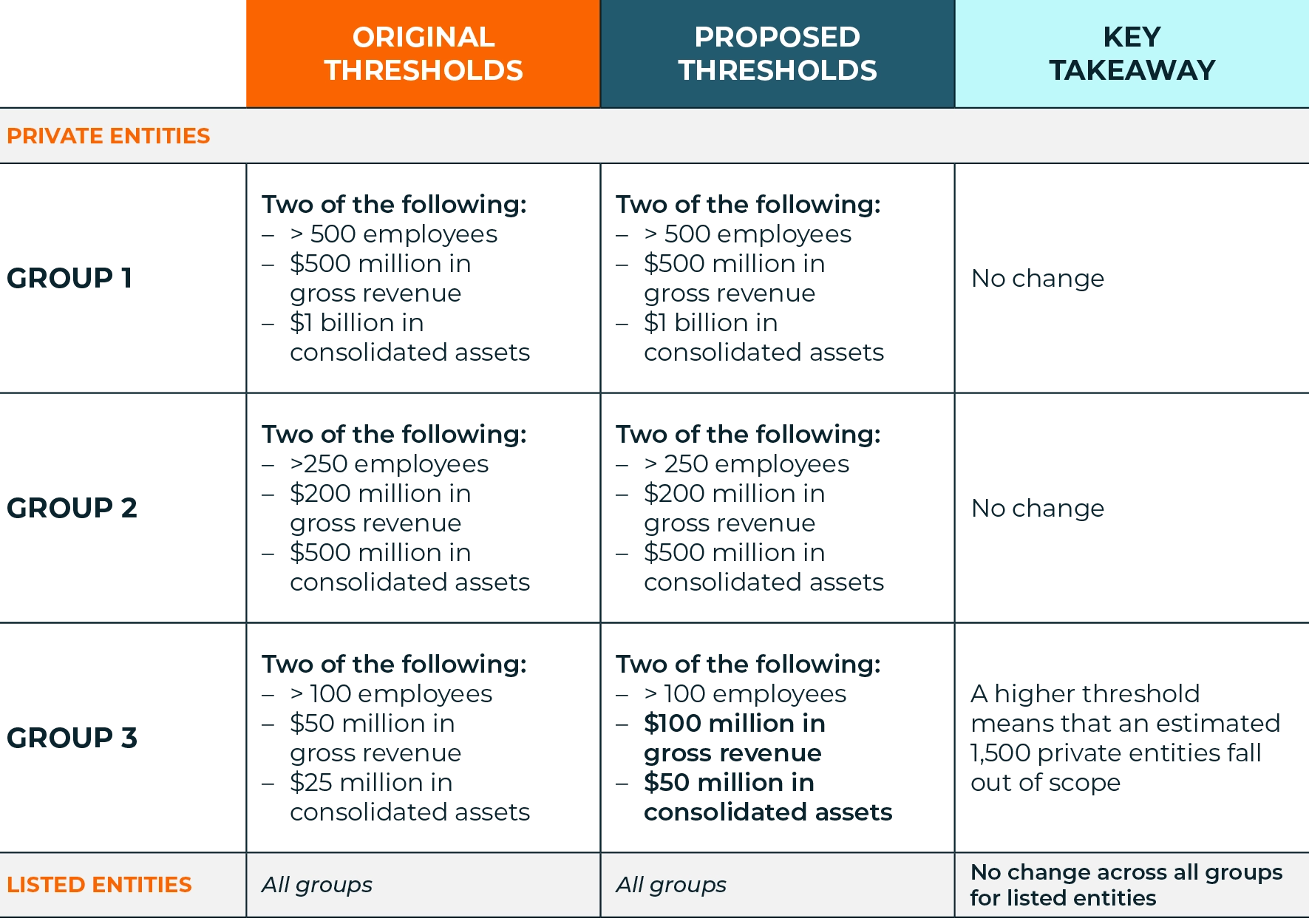
The most significant change is a proposed increase to the financial thresholds that determine whether a proprietary company (a privately held business not listed on the stock exchange) is classified as ‘large’ for reporting purposes. Under the proposal, fewer proprietary companies would be subject to mandatory reporting requirements. For Group 3 proprietary companies, consolidated revenue would rise from $50 million to $100 million, and gross assets from $25 million to $50 million, meaning proprietary companies below these revised levels would fall outside the climate reporting regime. The 100-employee headcount threshold remains unchanged.
Source: Department of Finance (Cth), Whole-of-Government Regulatory Reform Agenda (Fact Sheet, 2026).
Proprietary companies that fall below the revised thresholds would no longer be required to lodge audited financial reports, directors’ reports, or sustainability reports with the Australian Securities and Investments Commission (ASIC). The Government estimates around 1,500 private entities would be removed from direct mandatory reporting obligations as a result.
These proposed changes will apply to proprietary companies only. Listed entities will remain subject to the existing size thresholds under the AASB S2 climate disclosure regime and the Corporations Act 2001, and their reporting obligations will be unaffected.
Further measures under consultation
The Budget also identifies three areas under active consultation, where final settings have not yet been determined.
First, the Government proposes to clarify how the ‘undue cost or effort’ exemption applies in practice. This proposal would allow companies to omit Scope 3 emissions categories where measurement is not yet practicable. While Scope 3 reporting is not currently required under AASB S2, it will be phased in from 2027. The proposed clarification aims to give entities greater certainty about when and how the exemption can be applied once those obligations come into effect.
Second, assurance requirements are under review. Under the current framework, climate disclosures require limited assurance from the outset, stepping up to reasonable assurance – the standard applied to a full financial audit – by 1 July 2030. This timetable currently applies uniformly across all reporting entities. The Government’s proposal is to make the step-up to reasonable assurance more proportionate to the size and reporting maturity of each entity, which could mean a later or more gradual transition for smaller or less established reporters.
Third, the budget proposes clearer limits on supplier information requests. Small businesses are specifically identified as a group that should not face unreasonable data collection demands from larger entities in their supply chain.
What has not changed
The phasing schedule for AASB S2 is unchanged. Group 1 entities are already reporting. Group 2 entities commence for financial years beginning on or after 1 July 2026, and Group 3 follows from July 2027. The mandatory climate disclosure framework remains in place, and the consultation measures outlined above are not a basis for delaying preparation by entities.
What this means for Boards
The Government has been explicit that any reforms must “reduce burden while maintaining core sustainability requirements” (Budget Paper No. 2, 12 May 2026) – a framing that signals recalibration, not retreat.
For entities in global supply chains, domestic thresholds are only part of the picture. Companies supplying European manufacturers may face obligations under the EU’s Corporate Sustainability Reporting Directive (CSRD), and those servicing multinationals may be asked to provide Scope 3 data regardless of what Australian law requires. The question for Boards is not only what regulation applies, but what customers and investors expect.
A Board’s responsibility to understand and oversee material climate-related risks and opportunities does not change with any proposed adjustments to disclosure thresholds. These budget measures warrant a review of reporting assumptions, but they do not change the underlying imperative that climate governance remains a Board priority regardless of where an entity sits relative to thresholds. For those struggling to build Board traction on climate reporting, the risks of delay are real: ASIC scrutiny, reputational exposure, and investor pressure at AGMs do not pause while internal conversations stall. That scrutiny is sharpening – ASIC has identified financial reporting misconduct as an enforcement priority for 2026-27 and has confirmed it will actively review sustainability reports lodged under the mandatory climate reporting regime, applying the same expectations it brings to financial reporting.
For many entities, the practical challenge is less about understanding the rules than translating them into governance action that satisfies both regulators and investors. Boards should test whether revised thresholds affect their obligations and monitor how consultation outcomes may reshape assurance timelines. Sodali & Co. works with reporting teams and Boards to navigate exactly that.
Get in touch
Sodali & Co advises organizations on sustainability reporting obligations, investor engagement, and governance strategy. If you have questions about how these changes apply to your organization, contact our team.
For further insights on how Australia's first climate reporters are navigating AASB S2, read our recent article, AASB in Practice: Early Structural & Governance Insights from Australia’s First Climate Reporters.
Summary
The 2026-27 Australian Federal Budget proposes raising financial thresholds for mandatory climate reporting under the Corporations Act 2001, notably increasing Group 3 proprietary companies’ revenue and asset limits, thus exempting about 1,500 private entities from reporting, while maintaining existing requirements for listed entities and ongoing phased implementation of AASB S2 standards