

Subscribe to stay informed, inspired and involved.
Subscribe
Sign up with your email

What a year we’ve had. For business leaders, by any measure, 2025 was fast and furious, marked by shock, change, crisis, and conflict. Much of this pace, uncertainty, and volatility was centred around just one man. From the moment he took office back in January, Donald Trump directed global business news and boardroom agendas.
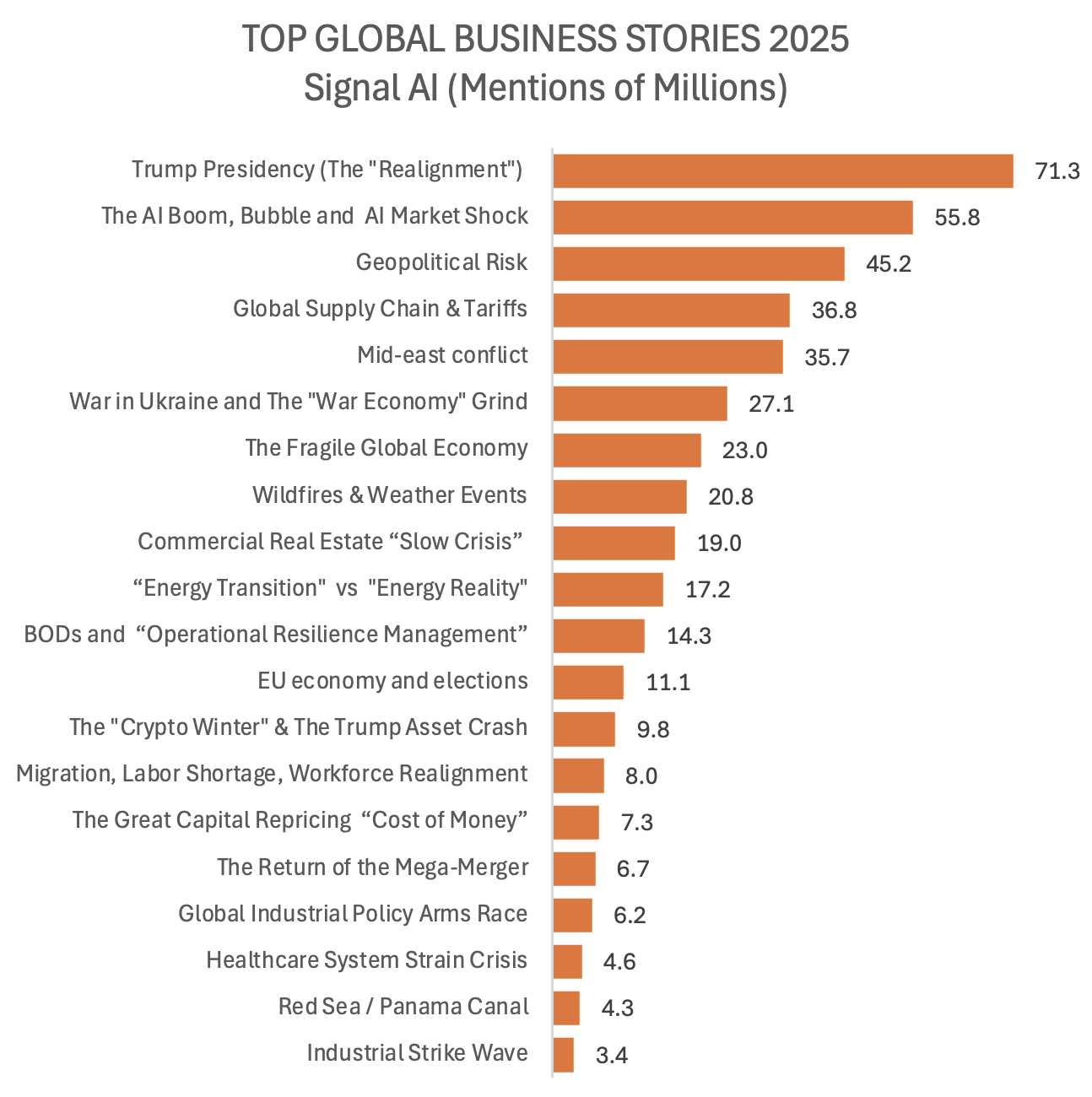
Our AI data trawl of the top 20 business stories in MSM worldwide in the past year (see top chart below) puts his presidency and its policies far out in front with 70 million mentions. AI ranked second with 55 million, while geopolitical risk, Middle East conflict, and supply chain made up the first five with over 45 million, 37 million, and 36 million, respectively.
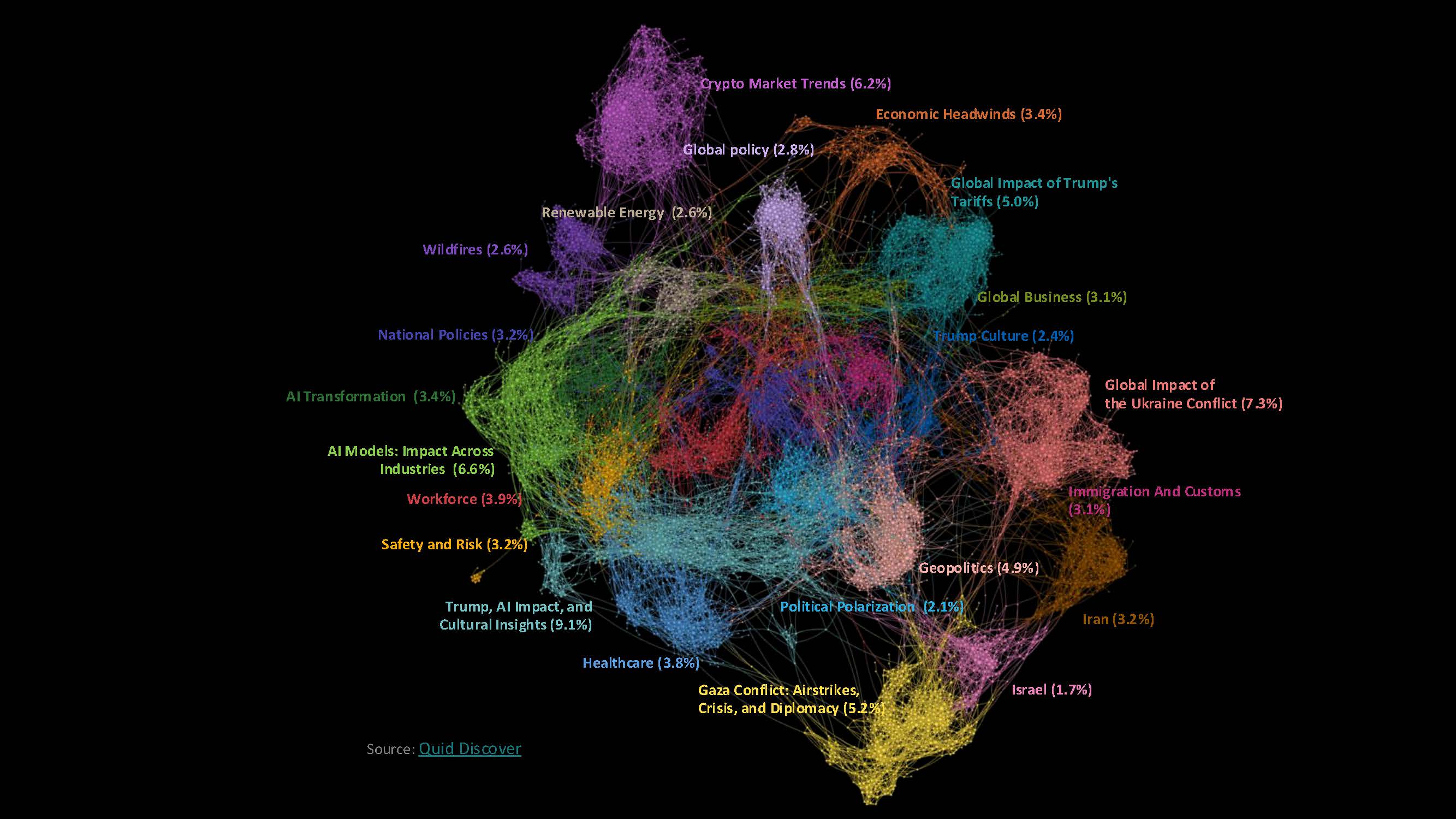
We also examined how the top business news storylines played out on social media, where the dense connections highlighted by the QUID Discover tool (see right) emphasize strong connections between them, with commentators and message posters actively engaging across multiple topics.
On their own, each of these top 20 stories was compelling and challenging enough. But they came in rapid succession, and they were often linked. In 2025, CEOs found themselves grappling with a host of complex issues, demanding quick-fire responses, like never before.
This is the reality of an increasingly interconnected business world - CEOs are like military planners, tasked with winning a war on multiple fronts.
In the past, it wasn’t like this. Sure, corporate chiefs faced a variety of problems, many of them big and complex, but they did not join and feed off each other, not like they do today. The modern business challenge is not government policy or technology or energy or workforce or supply chain individually, but the domino effect these forces, and more, have on each other.
In this new, sudden-shifting environment, CEOs don’t fail because they didn’t care about resilience or stakeholders. They fail because they made the wrong trade-offs under cascading pressure.
In 2025, CEOs don’t lose trust because they’re silent. They lose trust because events rewrite their story faster than they can. CEOs must pre-author and control the narrative of disruption as much as possible - so future upsets reinforce, rather than contradict, the company’s identity and stability, and their ability to manage.
Vital, carefully-constructed linear plans no longer cut it. Anything can happen to upset the best-laid strategy. The speed of comms says it will occur in a flash and be everywhere – embedded before you know it.
CEOs must be ready for any eventuality, linear and non-linear, homegrown and external. Threats can present anywhere at any time. CEOs must anticipate disruption, adapt rapidly, and ensure operability - even in the face of unforeseen events and intense scrutiny. They need eyes and ears everywhere. Take trade and supply chain - they can be disrupted by geopolitics, and conflict and climate all at once.
The Global Risks Report 2025 describes a ‘fractured’ landscape where geopolitical, environmental, societal, and technological risks interact and threaten stability. The OECD warns that advanced economies risk a significant GDP loss if they move too quickly to localize supply chains because of the deteriorating geopolitical environment.
AI is stopping for no one. It continues its developmental surge, not slowing but accelerating, creating workforce challenges compounded by skills training and migration barriers, energy similarly skewed by supply gaps, emissions controls, GPU availability, not to mention a pantheon of ever-evolving regulatory, security, and operational hurdles. Meanwhile, quantum and the transformation that will bring is fast-approaching. And did someone say climate change?
All of which sounds daunting and insurmountable, but it needn’t be, if you take these actions:
- Build and embed systemic resilience. Identify weaknesses, prioritize what must be protected. Choose, before you have no choice.
- Update your governance cadence. Slow is not an option; boards and decision-making must be structured to move at speed.
- Prepare to be pragmatic. In a crisis, listening to everyone is a recipe for frozen. Leadership means choosing which stakeholders to disappoint - and explaining why.
- Develop a protocol for what gets ignored. Don’t drown in dashboards, develop signal triage – explicit rules for which risks are ignored until proven existential, and which trigger immediate executive intervention.
- Move from defense to offense. Resilience is no longer about securing adequate cover – get it right, and it’s also a competitive weapon that provides an edge and creates opportunity.
The last 12 months show that nothing exists in isolation. Likewise, nothing is easy, nothing is a given. But at Sodali, we’re here to help, to put corporates, their CEOs, and senior teams in the best possible position, and to instil reassurance. In 2026, we look forward to enabling our clients to anticipate, adapt, and operate their way to success.
Happy New Year
Summary