Subscribe to stay informed, inspired and involved.
Subscribe
Sign up with your email

Power reliability is now affecting rents, retention, and underwriting
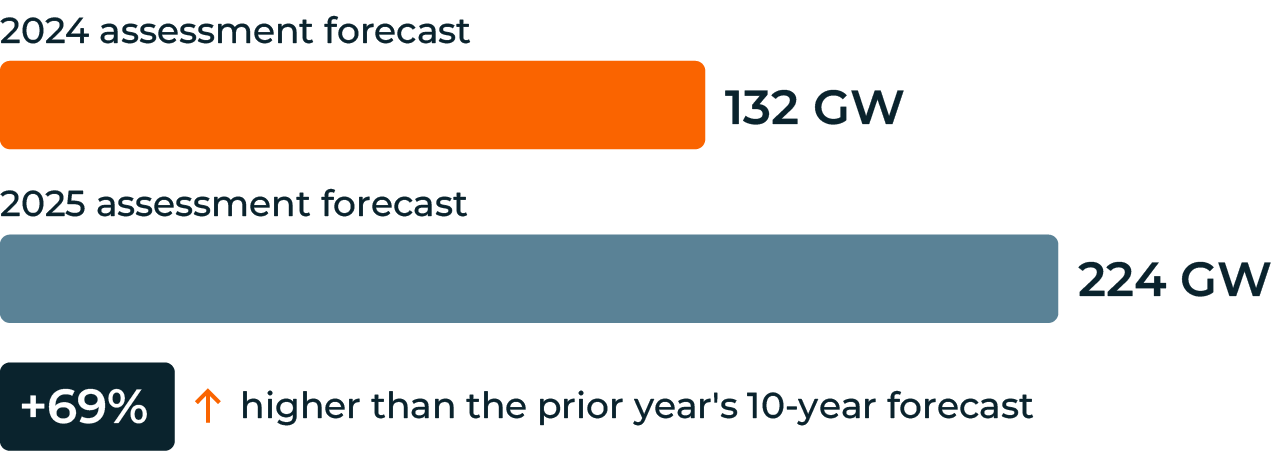
Planning early for power constraints may help owners manage risks to rents, tenant retention, and net operating income (NOI). Power availability is no longer a data center-specific issue. The North American Electric Reliability Corporation’s (NERC) 2025 Long-Term Reliability Assessment projects summer peak electricity demand growing 224 gigawatts (GW) over the next decade, a 69% jump from the prior year’s forecast, with 13 of 23 assessed regions in the United States and Canada now facing elevated or high risk of falling short on supply.[1] Electricity reliability and cost are increasingly influencing site selection, tenant retention, and underwriting across industrial, office, and multifamily assets alike.
Industrial: Power Capacity Can Affect Rents and Site Selection
For industrial and manufacturing tenants, power has become a primary site selection determinant rather than a secondary consideration. The stakes are highest in advanced manufacturing, such as semiconductor fabrication, where a momentary lapse in power can cost millions in lost production. This is already showing up in rents: in Silicon Valley, industrial leases for properties with high, consistent electrical capacity, typically 4,000 amps or more, closed with rents 49% higher, on average, than other leases over the past three years.[2] Markets that are unable to demonstrate reliable capacity are increasingly excluded from consideration, regardless of their other advantages.
Office: Tenant Requests Are Changing
Office tenants are changing what they ask for before they sign. Landlords report tenant requests for energy resilience features, such as backup power beyond life-safety loads and modern building management systems, that were uncommon even two years ago.[3] For office owners, these expectations are quickly becoming part of how buildings compete for tenants.
Multifamily: Outages and Electrical Capacity Add Pressure
Multifamily owners feel this pressure in two ways. In markets prone to outages, buildings that lose power face negative reviews and higher resident turnover.[4] Electric vehicle charging adds a second strain: residents increasingly want it, but adding charging means installing far more electrical capacity than the current building supports. For a 300-unit property, charging for 50 to 75 cars can require 25 to 40% more capacity, often costing hundreds of thousands of dollars upfront.[5] Meanwhile, utility costs are rising faster than rents in several markets, leaving owners with less margin to work with.
Across Asset Classes: Utility Costs Can Compound
Across all three asset classes, the cumulative effect matters; the five steps at the end of this article show where owners can start to manage it. A modest single-digit annual rise in utility costs can compound to 40 to 50% over a typical 10-year hold, which is enough to impact NOI projections and underwriting.[6]
Resilience is becoming part of how buildings compete
Resilience, meaning a building’s ability to stay healthy, safe, and efficient despite extreme weather, grid stress, or rising energy costs, is moving into the capital plan. Owners of stabilized, already-built assets are treating it as an ongoing capital commitment rather than a one-time design decision. Some are retrofitting on-site generation and battery storage into properties that were never designed with resilience in mind, and these projects must compete for space in existing capital budgets. Others are using efficiency measures and digital controls to shift load and reduce peak consumption, an approach known as demand flexibility, which lowers operating costs for occupiers and eases the strain on the grid.[7] That same capability allows owners to enroll in utility demand response programs, which pay participants to reduce load during periods of peak grid stress. As a result, measures that help the grid can also benefit the building.
Office Response: Presenting Resilience as a Performance Package
For office owners, energy resilience features may increasingly support rent premiums and occupancy advantages. Corporate occupiers want buildings that pair renewable energy with dependable backup power, and properties offering both may attract the most creditworthy tenants on the longest lease terms.[8] Owners should therefore market resilience as part of a broader performance package, presenting on-site solar, battery storage, backup power, and grid-interactive capabilities (systems that adjust energy use in response to grid conditions) together rather than as standalone amenities. This approach is likely to resonate most in primary markets with institutional ownership and credit tenants; in secondary markets, developers report that tenant willingness to pay for sustainability and resilience features is more mixed.[9]
Multifamily Response: Reliability Features Are Raising Resident Expectations
For multifamily owners, reliability features that were once luxury differentiators are becoming baseline expectations. In outage-prone markets, properties increasingly compete on backup generators for common areas, battery backup options, and building-wide microgrids.[10] Prroperties without these features risk losing residents to better-prepared competitors.
Resilience measures may also support compliance planning
The resilience measures that help owners manage grid risk and attract tenants can also help them meet a growing set of energy policies. Energy retrofits and efficiency upgrades build resilience directly: they can lower utility bills, help reduce strain during peak demand, and help support the long-term health of an owner’s investment.[11] These benefits matter even more as new energy policies, like building performance standards (BPS), proliferate; poor energy performance may trigger added expenses and operating risk.
Start With Your Exposure
To find where these benefits overlap, building owners and operators first need to identify current exposure to policy requirements like BPS. This can be done through a legal and title survey comparing asset locations to locations with BPS or other relevant policies. Using ENERGY STAR Portfolio Manager or other third-party data management software, owners can then see how assets perform across the portfolio. Combined with an understanding of where grid supply is most constrained, this data can help identify properties that stand to benefit the most from an energy audit and condition assessment. It can also help decisionmakers prioritize assets where a single upgrade can address both grid risk and policy exposure.
Plan Upgrades Together
Capital improvements planned this way can offer several benefits. They can help lock in operational efficiencies, reduce risk from future energy costs and compliance penalties, support asset value, and may help attract tenants or buyers. They may also offer a return on the investment, especially with a performance-based lease.[12]
Performance-based leases can help address the split incentive
Whether these upgrades move forward often comes down to who pays and who benefits. Under a typical net lease structure, in which tenants pay their own utility bills, building owners and tenants often face a split incentive. The owner is responsible for capital investments but does not see the cost savings from reduced energy consumption. Tenants see those savings but find it difficult to justify investing in space that they rent. This split incentive keeps both parties from making capital improvements, including those that support energy efficiency and resilience.
How Green Leases Can Help Align Owner and Tenant Incentives
Green leases are designed to close this gap. Owners and tenants both benefit from efficient buildings, but each controls different aspects of building performance. A green lease sets out those responsibilities from the beginning, so both parties are on the same page. The most sophisticated type, the performance-based lease, can be particularly well-suited to supporting compliance with energy performance policies such as BPS.
Two Clauses That Can Support Cost-Sharing and Transparency
One way it does this is through a cost recovery clause, which allows owners to pass some of the capital costs of improvements that reduce operating expenses through to the tenant. Both parties may then benefit from lower operating costs and a more efficient building. The lease can also include utility data sharing and transparency agreements, giving both parties the information they need to identify cost savings and support compliance with reporting efforts. These are only two examples of many performance-based lease clauses. For sample clauses and other information, visit the Green Lease Leaders website.
Five steps owners can take now
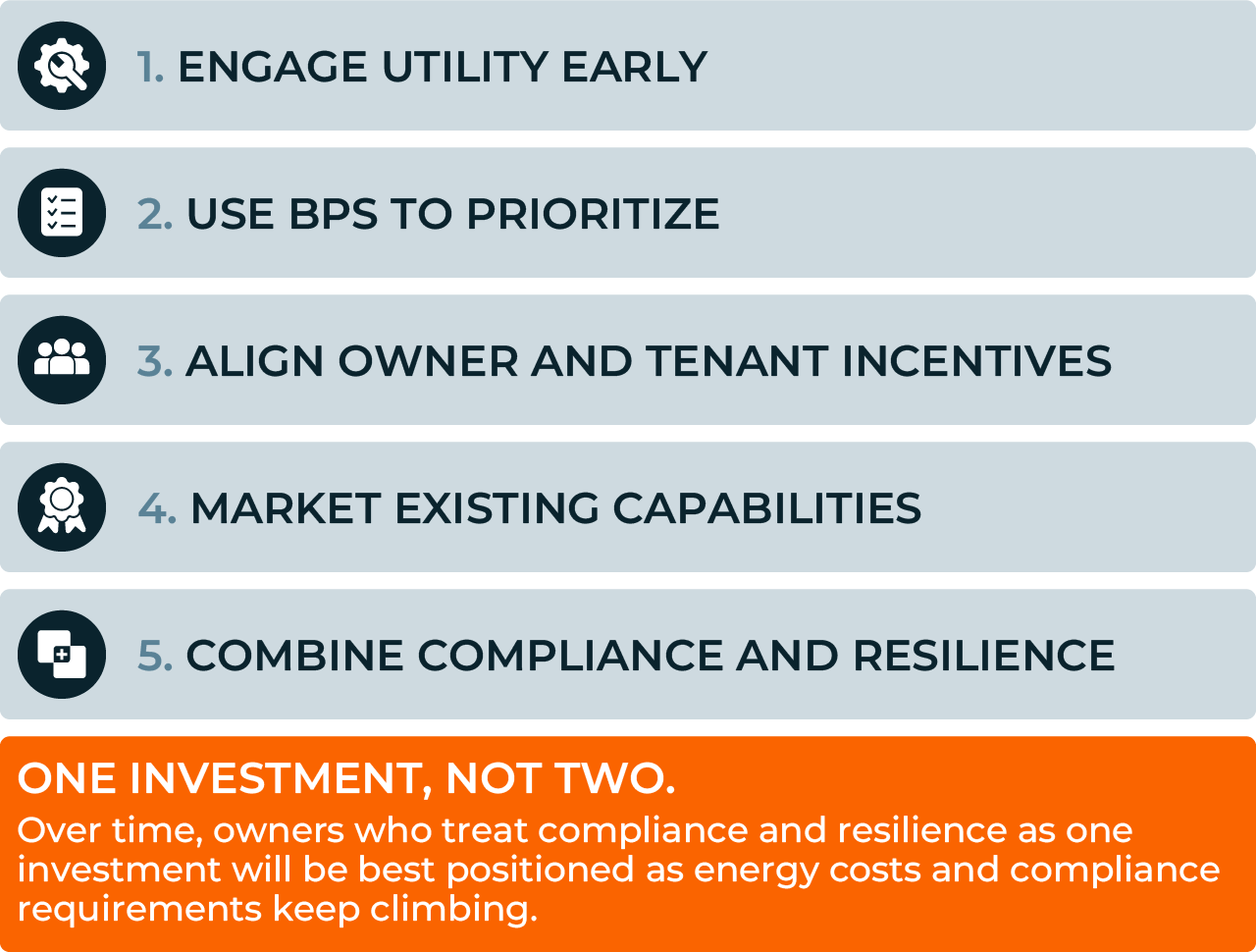
Grid strain and rising energy costs are reshaping tenant expectations, capital planning, and how owners approach policy compliance. Owners do not need to address every lever at once. These five steps, in order, can help owners start planning for grid and compliance risk:
Talk to our Sustainability team about your portfolio
Not sure where your portfolio is most exposed? The Sodali & Co Sustainability team can help owners turn these steps into a portfolio plan, starting with an exposure review that maps grid constraints and BPS requirements across assets. The Institute for Market Transformation (IMT) offers research and resources on green leasing and BPS that can support that plan. Contact the Sodali & Co Sustainability team to schedule an exposure review. For green leasing guidance and sample clauses, explore IMT’s green leasing resources.
About the Sodali & Co Sustainability Advisory team
Sodali & Co’s Sustainability Advisory team partners with companies to turn sustainability and resilience into drivers of long-term business value. On energy supply constraints, the team helps building owners understand where their portfolios are most exposed to grid instability or regulatory requirements like BPS, chart a path toward greater energy resilience through renewables or decarbonization, and build those priorities into how capital gets allocated.
About the Institute for Market Transformation (IMT)The Institute for Market Transformation (IMT) is a nonprofit that advances energy efficiency and building performance policy to create a more sustainable and resilient built environment. IMT produces research, resources, and standards on topics like green leasing and BPS that help owners align leasing and policy compliance with resilience goals.
-
NERC, Long-Term Reliability Assessment, January 2026 ↩
-
JLL Research, Where Energy Meets Property, February 2026 ↩
-
CREDA, Electric Grid Reliability and Commercial Real Estate, July 2026 ↩
-
CREDA, Electric Grid Reliability and Commercial Real Estate, July 2026 ↩
-
CREDA, Electric Grid Reliability and Commercial Real Estate, July 2026 ↩
-
CREDA, Electric Grid Reliability and Commercial Real Estate, July 2026 ↩
-
Lawrence Berkeley National Laboratory, Demand Flexibility ↩
-
CREDA, Electric Grid Reliability and Commercial Real Estate, July 2026 ↩
-
CREDA, Electric Grid Reliability and Commercial Real Estate, July 2026 ↩
-
CREDA, Electric Grid Reliability and Commercial Real Estate, July 2026 ↩
-
Institute for Market Transformation, Building Performance Standard Module: Resiliency, May 2022 ↩
-
Institute for Market Transformation, How Green Leasing Supports BPS Compliance, October 2023 ↩
Summary
Planning early for power constraints may help owners manage risks to rents, tenant retention, and net operating income (NOI). Power availability is no longer a data center-specific issue.
Author

Carson Smith
Senior Manager, Sustainability
carson.smith@sodali.com

Diana Lee
Director of Business Engagement, Institute for Market Transformation (IMT)

David Gillick
Associate Director of Business Engagement, Institute for Market Transformation (IMT)